We are experts
for feeding technology.
Efficient production processes begin with the reliable provision of components. The feeding technology from Hörmle GmbH ensures that components arrive at their place of use in the right position, at the right time and with a high level of process reliability. Our systems are individually designed and can be perfectly integrated into existing assembly, testing and production systems.


Why feeding technology
We offer you everything - from simple to complex:
Modular and combinable
Our feeding systems can be flexibly combined with other components - for example for the single or multiple provision of components with subsequent transfer to robots, high-speed loaders, gantry axes or handling systems.
Complex feeding systems
Individual components such as vibratory conveyors can be flexibly combined with other systems (e.g. linear conveyors, hoppers, robots, gantry axes) to create highly integrated automation solutions - perfectly tailored to specific customer requirements.
Our scope of delivery
Whether simple feeding solutions or complex, fully automated systems – we develop systems that are precisely tailored to your components, quantities and process requirements.
Bunker systems
A hopper system is used for bulk material feeding in order to store loose material such as screws, O-rings, bushes and much more, and to automatically and controlled discharge it into downstream processes. The aim here is to enable a continuous flow of material to downstream processes. It serves as a buffer between the material delivery and the point of consumption, such as a round conveyor or anyfeeder.
– Hopper: The actual storage tank for the bulk material, often with a special geometry to prevent bridging.
– Discharge device: Can be designed as a push floor, discharge screw or vibrating floor to reliably loosen and move the material.
– Conveyor technology: An integrated or separate conveyor system such as a belt hopper or inclined conveyor to transport the material to the target machine.
– Control system: Automates the refilling process and regulates the delivery rate, often with the integration of fill level sensors.
– Additional equipment: Depending on requirements, noise protection enclosures, covers or special surface coatings, depending on customer wishes and feasibility.
We offer a comprehensive range of bunker system services. Our experience enables us to develop customized solutions that are precisely tailored to your specific requirements and applications.
We guide you through the entire process, from the initial planning and design to the turnkey implementation of your hopper system.
Contact us to discuss your requirements and receive a customized quote.
Conveyor belts
Conveyor belts are mechanical conveying systems that are used for the continuous transportation of materials and goods over horizontal or inclined sections within a plant. They are an indispensable part of modern industry and logistics.
A typical conveyor belt system consists of an endless loop of robust belt material (often rubber or fabric) that is guided over at least two rotating rollers. One of these rollers, the so-called drive roller, is motorized and generates the necessary movement of the belt and transported goods through friction.
- Belt conveyors: The most common form, ideal for piece goods and bulk goods.
- Roller conveyors:Transport goods on driven or non-driven rollers.
- Chain conveyors:Are often used for heavier loads or special applications.
Our team of experts is ready to analyze your specific requirements and provide you with tailored recommendations designed for efficiency and reliability.
For individual advice and to find the optimum conveyor belt solution for your business, please contact our sales department.
Linear actuators
A linear actuator is a mechanical component that converts rotational movement or energy into a straight-line (linear) movement. Its main purpose is the precise positioning, lifting, lowering, pushing or pulling of a load over a defined, often shorter, distance.
Linear feeders
A linear conveyor is a system designed to transport material, products or workpieces continuously or in discrete steps from one point to the next along a straight line. The focus here is on material flow and handling, typically in industrial manufacturing environments.
- Movement:Generates a directed, often continuous or cyclical movement for the transportation of goods.
- Energy source: Often driven by electric motors or magnets which then generate a forward movement through vibration.
- Precision:The positioning accuracy is usually lower than with linear actuators, as it is primarily a matter of transportation.
- Different rails, which are screwed onto the linear conveyor, are adapted to the respective goods to be conveyed.
- Linear feeder is the compensation of the bowl feeder feeding device of the power fluctuations, thus no backlog in the bowl feeder.
We offer a diverse range of linear conveyors and linear drives for a wide variety of industrial requirements. Our approach is to work with you to determine the specific needs of your application.
Robotics
Robotics, also known as robotics, is the scientific and technical discipline that deals with the design, construction, operation and application of robots. It is an interdisciplinary field that combines elements of mechanics, electronics, electrical engineering, computer science and control engineering.
Fundamentals of robotics
The core components of a robot include:
- Mechanical structure:The physical body and the joints (actuators) that enable movement.
- Sensors: Systems that collect information about the environment (e.g. cameras, touch sensors).
- Control system & software:The “brain” of the robot, which processes commands and coordinates movements.
- End effectors: Tools at the end of the robot arm (e.g. grippers, welding tools) that perform the actual task.
We have already planned, implemented and successfully commissioned a large number of robot applications in our systems. Our experience in automation technology has enabled us to develop customized solutions for various industrial requirements. We attach great importance to using innovative technologies to continuously optimize the efficiency, precision and flexibility of our production processes.
Our wealth of experience grows with every successfully completed robot integration, which enables us to tackle future automation projects in a confident and targeted manner.
Vibratory conveyor
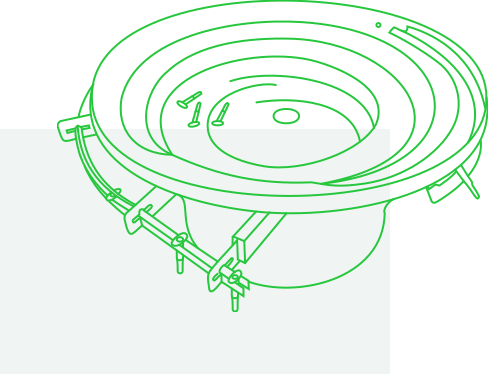
Vibratory conveyors (also known as vibration conveyors, circular conveyors or spiral conveyors) are mechanical conveying devices that use vibrations to transport bulk materials or individual workpieces along a chute or pipe.
Conveying is based on a micro-throw motion principle. A drive, usually an electromagnet or unbalanced motor, generates a fast, directed oscillation. This oscillation accelerates the conveyed material upwards at a certain angle. Gravity causes it to fall back into the chute and the frequency of the vibration moves it forwards.
Vibratory conveyors are often used in industry because they are robust and can be easily adapted to different applications:
- Feeding in production processes:Precise dosing of small parts (e.g. screws, nuts) to processing machines or assembly stations.
- Sorting and screening:Separation of materials according to size.
- Material transport: Horizontal transport of bulk goods such as screws, O-rings, connector housings, contacts and much more.
- Manufacturing industry:Supply of bulk material that is to be fed into a system in a specific position.
Advantages
- Versatility:Transporting a wide variety of materials and bulk goods, from fine/light plastic parts to coarse/heavy steel parts.
- Hygiene/contamination:Easy to clean, as open channels and tracks are often used and there are no moving parts in the flow (important in the food and pharmaceutical industries or electrical industry).
- Robustness: Low wear and low maintenance.
- Dosing capability: The conveying speed can often be controlled very precisely.
Customized special solutions for every challenge
Every company is different and requires different technologies, systems and machines. We take this fact into account for every single product that we design and manufacture for our customers. In short, the customer always comes first at hörmle GmbH.