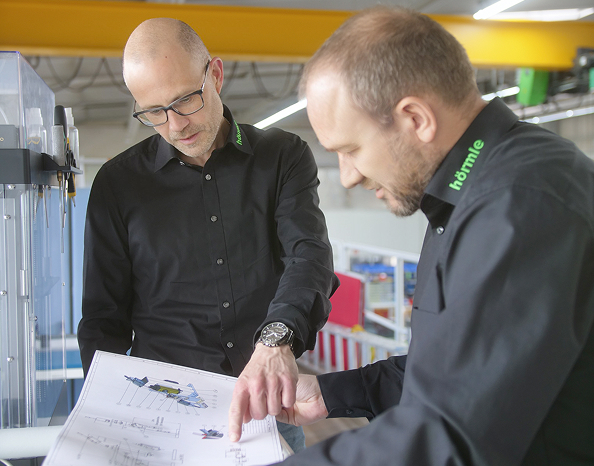
We are experts
for testing technology.
Depending on the requirements and customer wishes, we use a wide variety of inspection systems. In addition to visual inspection, we also use special inspection mandrels and thread inspection mandrels.



Why testing technology
We offer you testing with precision:
Quality assurance at the highest level
With 100% control directly in the production process, hörmle ensures maximum process reliability, reduces reject rates and increases the overall efficiency of production.
Modular system architecture
hörmle's inspection systems have a modular design and can be flexibly integrated into existing production lines.
Our test systems
At hörmle, we develop individual inspection technology solutions that precisely match your production requirements – whether optical, tactile or pneumatic part inspection.
Measuring probe
Optical part inspection in plant engineering (also known as automatic optical inspection, or AOI for short) is a key non-destructive testing (NDT) process in which the surfaces and geometries of components are inspected for visible defects, faults or shape deviations in a non-contact process.
Automated optical inspection systems use advanced image processing algorithms and sophisticated sensor technologies, often supplemented by artificial intelligence (AI), to ensure high accuracy and efficiency.
- Image processing systems (machine vision): At the heart of AOI are camera systems (often high-resolution or stereoscopic) that record images of the test object.
- Lighting techniques:Special lighting (e.g. grazing light, flash light) is used to emphasize features such as scratches, deformations or the presence of certain components.
- 2D and 3D measurement techniques:
- 2D inspection: Focuses on surface defects, color deviations or the presence/absence of components.
- 3D inspection: Uses methods such as laser scanning to precisely measure and compare component heights, geometries and shape tolerances.
- AI and machine learning: Modern systems use AI to automate and continuously improve image recognition and classification of defects, which further increases precision.
In plant engineering, optical parts inspection is used in various phases of the production process, from incoming goods inspection to in-line production monitoring and final acceptance.
- Geometry inspection: Checking shape and position tolerances, dimensional accuracy and contours of components.
- Surface inspection: Detection of cracks, corrosion, scratches, deformations or other surface defects.
- Assembly check: Check for completeness and correct positioning of inserts or assemblies.
- Positional feeding: Ensuring the correct alignment of parts for subsequent automated processes.
Advantages
The integration of automated optical inspection systems into plant engineering offers considerable advantages:
- Increased quality: Early detection of errors reduces rejects and rework.
- Efficiency: Automation speeds up the inspection process considerably compared to manual visual inspection.
- Reliability: Minimizes human error and ensures seamless, objective monitoring.
- Documentation: The systems enable detailed data acquisition and statistical evaluation for quality assurance.
Pneumatic length measurement
Pneumatic length measurement (often referred to as dynamic pressure measurement ) is a non-contact measurement method based on the laws of fluid mechanics. It is extremely precise and is primarily used in quality assurance in industrial production.
The operating principle is simply explained here:
The basic principle
The process uses compressed air as a “probe”. A measuring nozzle is positioned a short distance in front of the surface of the workpiece. The air flow exiting the nozzle is impeded by the resistance of the workpiece.
The process
- Constant pressure: The system is supplied with an absolutely constant inlet pressure.
- The measuring nozzle: The air flows through a pre-throttle and then exits the measuring nozzle.
- The air gap: The distance between the nozzle and the workpiece forms a ring-shaped cross-section. If this distance (the length) changes, the flow resistance also changes.
- Change in dynamic pressure: As the workpiece moves closer to the nozzle, the air backs up more. This dynamic pressure is measured.
Evaluation
The measured pressure is in a direct (linear) relationship to the distance. Small changes in distance lead to measurable changes in air pressure, which are then displayed on a scale or digitally as a linear value.
Why do you use it?
- Non-contact: No scratches on sensitive surfaces.
- Self-cleaning: The outflowing air simply blows away oil, coolant or chips.
- High precision: Differences in the range of less than 1µm (0.001 mm) can be detected.
- Wear-free: As there is no mechanical contact, the measuring device does not wear out.
Application example: The inspection of bore diameters in engine blocks where the smallest tolerances are important.
Tactile parts inspection
Tactile parts inspection in plant engineering is a precise quality control process in which the physical dimensions and geometry of components are recorded by direct contact with a measuring device. This method is crucial for ensuring the dimensional accuracy and accuracy of fit of components that are installed in complex machines and systems.
Importance in plant engineering
In plant engineering, where maximum precision and reliability are essential, tactile testing plays a central role in quality assurance.
- Ensuring a precise fit: Components must correspond exactly to the specifications in order to fit together seamlessly during assembly and ensure that the entire system functions correctly.
- Detection of defects: Dimensions, shapes and surface finishes are precisely checked in order to detect defects such as shape deviations, damage or processing errors at an early stage.
- Compliance and documentation: The measurement results serve as proof of compliance with quality standards and technical specifications, which is relevant for certification and liability.
Crack testing
Crack testing with the eddy current method: Non-destructive, fast & precise
- Fault-free material: The eddy currents flow evenly.
- Crack in the material: A crack or an inhomogeneity disturbs the flow of eddy currents (they must “flow around the fault”).
- Signal change: This disturbance changes the eddy current’s own magnetic field, which is registered by the measuring coil as a change in impedance (electrical resistance) and displayed on the screen as an error signal.
- Non-contact: The probe does not have to touch the workpiece, which minimizes wear.
- High speed: Due to the fast electronic measurement, the method is ideal for automated 100% tests directly in the production line (online).
- No coupling agents: In contrast to ultrasonic testing, no gel or oil is required.
- Paint tolerance: Cracks can often be detected through thin layers of paint or coatings.
Incident light
Hardness test
Camera systems
Customized special solutions for every challenge
Every company is different and requires different technologies, systems and machines. We take this fact into account for every single product that we design and manufacture for our customers. In short, the customer always comes first at hörmle GmbH.